Why Does Concrete Sink in Minnesota? Soil, Frost, and Water
Concrete settling and cracking is usually caused by the ground underneath it moving, and the slab goes along for the ride.
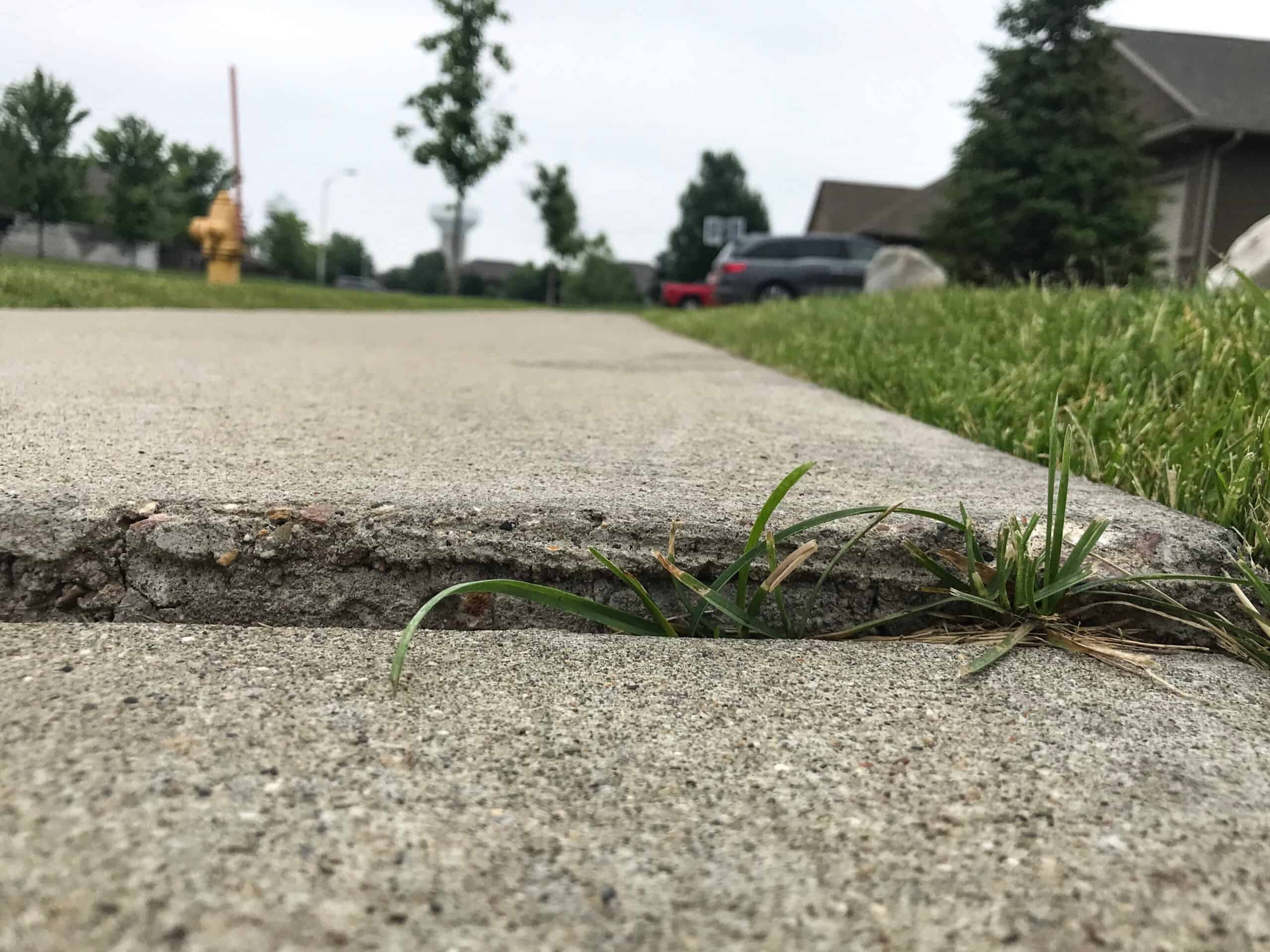
In Minnesota, that movement comes from three sources: soil that was never dense enough to begin with, water that erodes and saturates it, and a freeze-thaw cycle that lifts the ground in January and pulls the support out from under it in April. Those three sources show up as five specific causes, and most problem slabs have more than one.
Last verified: October 6, 2026.
The short version
The Federal Highway Administration’s engineering manual for pavements lists three conditions that have to be present at the same time for frost to move the ground: a frost-susceptible soil, subfreezing temperatures reaching down into that soil, and a source of water. Minnesota supplies all three every winter.
The part that matters for your driveway is what comes next. If those three conditions are spread evenly across a slab, the whole slab lifts together and settles back together and you never notice. Where they are not even, the manual describes the result: differential heaving, “causing surface irregularities, roughness, and ultimately cracking of the pavement surface.”
Your house is below the frost line. Your driveway is not.
Minnesota Rule 1303.1600 sets the minimum footing depth for frost protection. In Zone II, which covers Anoka, Carver, Dakota, Hennepin, Ramsey, Scott, Sherburne, Washington and Wright counties along with most of southern Minnesota, that minimum is three and a half feet. In Zone I, the northern counties, it is five feet. Going shallower takes supporting evidence from an engineer competent in soil mechanics.
That rule governs buildings. It has nothing to say about your driveway, your sidewalk, your patio or your garage apron. No Minnesota rule requires flatwork to bear below the frost line, and in practice essentially none of it does. A slab a few inches thick on a few inches of base sits entirely inside the zone that freezes and thaws every year.
So on the same lot, in the same winter, you have two structures behaving in completely different ways. The house is anchored below the frost. The concrete around it is floating on top of it.
Five ways the ground moves under a Minnesota slab
Two come from the soil itself, one from water, and two from frost. Each leaves a different signature, and you can usually tell which one you have without anyone opening anything up.
Backfill that was never properly compacted. When a foundation is dug, far more soil comes out than goes back in undisturbed. What goes back is relatively loose, and it keeps consolidating for years under its own weight and every rain that soaks it. Minnesota Rule 1303.1600 shows what the state considers safe ground for a slab. A building can sit on a slab instead of deep footings only if the soil beneath it, all the way to frost depth, is sand or pit-run sand and gravel with less than 70 percent passing a No. 40 sieve and less than 5 percent passing a No. 200. Native fine-grained spoil scraped back into a trench does not come close, and no rule asks your driveway to meet even that.
How to tell if this is yours: the low area runs in a line rather than a pool, tracing where a trench or a foundation wall is. Or the slab that moved is the one poured within a year or two of the house, while older concrete on the same property sits fine.
Organic material breaking down underneath. If topsoil, stumps, roots or construction debris ended up under the slab, it is still decomposing. FHWA notes that topsoils “tend to settle over time as organic matter continues to degrade,” and that peats and organic soils produce significant settlement “even under light loads.”
How to tell if this is yours: one localized dish that deepens slowly and steadily with no seasonal rhythm. It does not come back up in winter and it does not accelerate in spring. It just keeps going.
Water carrying the fine particles out from underneath. Water moving through soil takes the smallest particles with it and leaves voids behind. The slab spans the void until it cannot, then it drops and sometimes cracks. Downspouts are the usual culprit, followed by grading that sends roof and yard water toward the slab instead of away, and by service trenches that give water an easy path.
How to tell if this is yours: the low corner is the wet corner. Stand outside during a hard rain and watch where the water goes. It usually only takes a minute to find.
Frost heave and ice lensing. FHWA describes frost heave as being “caused by crystallization of ice lenses in voids of soils containing fine particles.” As the freezing front works downward, it pulls unfrozen water up toward itself through the fine pores, and that water freezes into layers of clear ice inside the soil. Those layers take up more room than the water did, so the ground rises. When they melt, the soil they pushed apart does not always go back the way it was.
How to tell if this is yours: it moves up in winter, and each spring it comes back down a little short of where it started. Heave is the one cause that makes concrete go the wrong direction before it goes the right one.
Thaw weakening in spring. This is the specifically Minnesotan one, and the state has documented it for decades because it wrecks roads. MnDOT’s Local Road Research Board put the mechanism plainly in a 1993 synthesis on measuring frost depths: “As pavement temperatures increase in the spring, frozen layers under the pavement begin to thaw from the top. The water released from the thawing materials saturate and weaken the pavement structure as the water is not able to drain through the still frozen lower layers. Water starts to drain after most of the subgrade soil has thawed, and the fine-grained soils slowly regain strength.”
Read that again with your driveway in mind. The top thaws first. The meltwater has nowhere to go because the ground below it is still frozen solid. For a few weeks every spring, the soil holding up your concrete is as weak as it will be all year, and that is exactly when the plow truck, the delivery van and your own vehicle are still driving on it.
How to tell if this is yours: it was fine in October and it is off in April. Spring is when Minnesota slabs move, and this is why.
Why the state measures this, and what that tells you
MnDOT restricts truck weights on Minnesota roads each spring for the reason described above, and it publishes frozen soil profiles built from sensor data to decide when. The monitoring sites closest to the metro are Marine on St. Croix in Washington County and Otsego in Wright County. If the state considers the seasonal strength of thawing subgrade worth instrumenting and legislating around, it is not a small effect on a residential slab either.
One qualification: Minnesota is not automatically the worst case. FHWA observes that frost damage “may be most severe in the central states, where many more frost cycles occur than in the most-northern states.” The number of times the ground crosses freezing matters as much as how cold it gets. What makes the Twin Cities hard is the combination: enough cycles to work the soil, deep enough frost to reach well under flatwork, and the soils described below.
Silt, clay, and glacial till: what is actually under a Twin Cities slab
Nearly every article on this subject tells you clay is the villain because it swells when wet and shrinks when dry. That is half right, and the wrong half gets repeated most.
For frost heave specifically, silt is worse than clay. FHWA is direct about it: “Little to no frost action occurs in clean, free draining sands, gravels, crushed rock, and similar granular materials,” because the large voids let water freeze in place without forming lenses.
“Conversely, silts are highly frost-susceptible.” In the standard frost susceptibility classification, all silts land in group F4, the very high category. Clays sit lower, because although clay’s capillary potential is high, its capillary rate is low, so water cannot migrate to the freezing front fast enough to build large lenses.
Clay gets you a different way. The same manual notes that “the supporting capacity of clays must be reduced greatly during thaws, even in the absence of significant heave,” because thawing happens top down and leaves the upper soil saturated. Clay may not lift your slab much. It will absolutely stop holding it up in April.
What sits under most Twin Cities properties is glacial till, defined in the same manual as “a mixture of sand, gravel, silt, and clay produced by the plowing action of glaciers,” with Midwest tills running more plastic than their New England equivalents. The line worth remembering is the manual’s own summary: “the complex nature of their deposition creates a highly unpredictable material.” There are also varied clays in the metro, deposited in glacial lakes as alternating thin bands of silt and clay, which the manual describes as sensitive soils that lose strength when disturbed.
What you can actually do about the water
Of the five causes, water is the one you control. It is also the one feeding two of the others, since ice lensing and thaw weakening both need a water supply to work with.
The building code’s grading requirement is a reasonable target even for an existing house: the ground should fall at least six inches within the first ten feet away from the foundation, and hard surfaces within ten feet should slope at least two percent away from the building. Six inches over ten feet is more fall than most people picture. Go look at yours.
Beyond that, the short list is unglamorous and effective. Run downspouts well past the slab rather than to the edge of it. Keep control joints and the gap between slab and foundation sealed so surface water is not pouring straight into the base. Fix the low spot that ponds against the concrete before you fix the concrete. Drainage addresses the cause. Lifting addresses the symptom. On most jobs you want both, in that order.
Common questions
How do you fix sinking concrete?
The slab is lifted back to grade by injecting material through small holes drilled in the surface, which fills the voids underneath and raises the concrete. The two common approaches are polyurethane foam (polyjacking) and a cementitious slurry (mudjacking), and they differ in weight, cure time, hole size and cost. We compare them directly in our mudjacking and polyjacking guide, and the 2026 pricing guide covers what projects actually run.
Why does concrete sink when it rains?
It usually is not sinking during the rain. The rain is washing fine soil out from under the slab and creating a void, and the slab drops into that void later, sometimes months later. Heavy rain also saturates soil that is already weak. If your concrete moves noticeably after storms, treat it as a drainage problem first.
Is it the concrete or the soil?
Almost always the soil. Sound concrete that has settled is still sound concrete, and lifting it is worth doing. Concrete that is spalling, crumbling or broken into many pieces is a materials problem rather than a support problem, and lifting will not fix it. Those are different conditions with different answers, which is why a diagnosis should come before a quote.
Can I fix it myself?
Surface patching and sealing, yes. Lifting a slab, no. The equipment injects material under pressure into a void you cannot see, and the difference between a level slab and a cracked one is control you do not get from a rented tool.
When is the best time to lift concrete?
Once the ground has thawed and drained, usually from mid-spring through late fall. Lifting during the spring thaw means lifting on soil that is as weak as it gets all year, and lifting a slab that is heaved up on frozen ground means it will sit too high once that ground thaws. If your concrete dropped over the winter, the best move is usually to have it looked at in spring and lifted once the soil underneath has firmed up.
The exception are attached garage floors, heated outbuilding floors and interior lifting and stabilization projects. These types of projects can be done year round since they are protected from frost.
Will it sink again after lifting?
It depends on what made it sink. Lifting fills the void and restores support, but it does not change where your water goes. If a downspout or bad grading washed the soil out the first time, it will do it again. That is why we look at drainage first: fix the water, seal the joints, then lift, and the slab has a good chance of staying where we put it.
Getting a straight answer about your slab
If a slab on your property has moved, the useful next step is finding out which of these is behind it. We lift concrete across the Twin Cities on driveways, sidewalks, patios, garage floors and around foundations, and the full range of what we work on is on our services page.
If you would like to schedule an appointment with one of our Project Consultants to discuss your options, click Here to submit your information. We look forward to meeting you!